
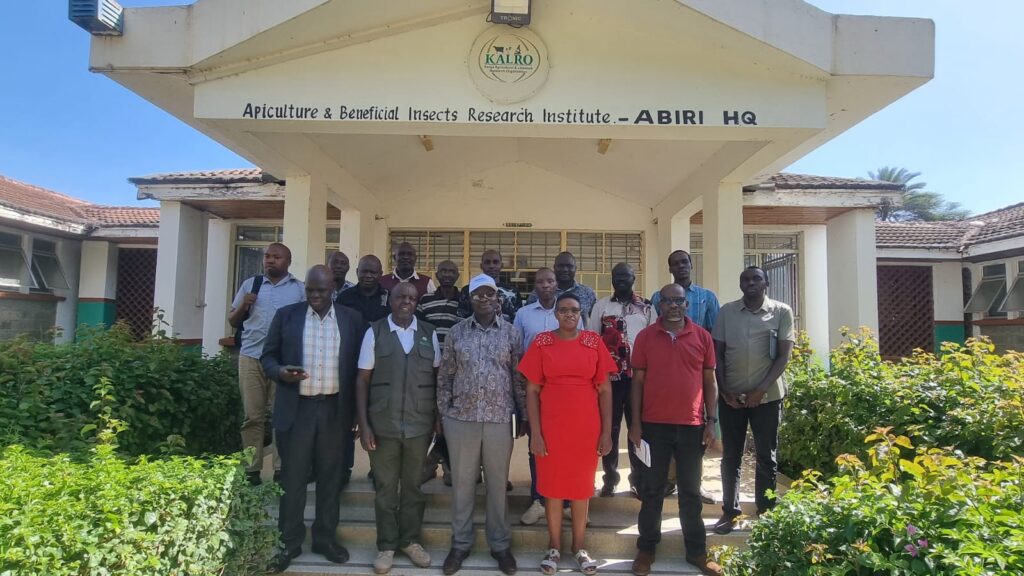
This January,the TAGDev 2.0 team from the University of Eldoret paid a consultative visit to the Kenya Agricultural and Livestock Research Organization ,Apiculture and Beneficial Insects Research Institute (KALRO–ABIRI) in Marigat. The meeting brought together key stakeholders from KALRO, KEFRI, CIMMYT, and the TAGDev 2.0 programme to explore areas of collaboration in research, innovation, and sustainable livelihoods in Kenya’s dryland regions
KALRO–ABIRI’s Research Mandate
KALRO–ABIRI under the leadership of Dr. Charles Bett provided a detailed overview of its mandate and ongoing work across livestock, apiculture, socio-economics, and soil health. Operating on approximately 200 acres, the Perkerra Centre undertakes both insect-related and broader agricultural research, including goat and Sahiwal cattle improvement, clean planting materials, and underutilised fruit crops such as guava.
The Centre highlighted several farmer-ready technologies, including biofortified beans like the Nyota variety, improved pigeon pea lines, bird-tolerant Jasiri sorghum, and improved rangeland grass varieties. KALRO’s emphasis on developing Technology, Innovation, and Management Practices (TIMPs),now being translated into local languages, underscored its commitment to scaling adoption among farmers across Kenya’s agro-ecological zones
Driving Youth Employment Through Action Research
The TAGDev 2.0 Programme, implemented by RUFORUM shared its vision of using action-oriented research to generate employment opportunities for young people. At the University of Eldoret, the programme focuses on the dairy value chain, from pasture and feed production to value addition and market access.
Implemented through the Agri-food Systems and Entrepreneurship Development(ASEC) framework, TAGDev 2.0 operates across selected counties in the Lake Region Economic Bloc (LREB) and the North Rift Economic Bloc (NOREB). The programme’s core goal is to ensure that research outputs are practical, scalable, and capable of delivering visible development impact, particularly for youth and women.
The Kenya Forestry Research Institute (KEFRI) led by Mr. Simon Choge highlighted its long-standing collaboration with KALRO in identifying suitable tree species for different ecological zones. Discussions focused on the National Prosopis Strategy, a ten-year plan ready for national rollout, with Baringo County among the priority areas. KEFRI also shared plans for upcoming plant restoration initiatives scheduled to begin in July 2026.
Meanwhile, CIMMYT noted its expanding mandate beyond maize and wheat to include a wider range of dryland crops, reflecting a strategic shift towards climate resilience and arid and semi-arid land farming systems
Aligning Efforts Through TAGDev 2.0 Work Packages
The meeting provided a platform to align institutional strengths with TAGDev 2.0’s five work packages:
- Community Engagement and Partnerships – strengthening farmer groups, youth networks, and extension systems.
- Research – promoting action research, student mentorship, and formalisation of seed systems, particularly for range grasses.
- Skilling and Retooling – building capacity across the dairy value chain, with strong inclusion of women, youth, refugees, and persons with disabilities.
- Incubation and – reaching up to 80,000 farmers through demonstrations, apiculture innovations such as propolis production, and market integration.
- Greening and Ecosystem Services – restoring drylands through fodder production, aerial seeding, and nature-based enterprises in collaboration with KALRO and KEFRI
The engagement concluded with clear action points, including compiling relevant TIMPs, addressing gaps in range grass seed systems, involving KALRO scientists in student research review, sharing the Prosopis National Strategy, and formalising partnerships through MoUs.
The Marigat meeting reaffirmed a shared commitment among research institutions and development partners to translate science into solutions that strengthen dryland agriculture, restore ecosystems, and create meaningful employment opportunities for Kenya’s youth.